
Find Peachtree City Residents
Where you start depends on what you already know. A street address sends you to the Fayette County tax roll and parcel map. A full name opens several doors. The deed index, the local court docket, and voter tools all count, and so do probate files and official state registers. An older address calls for plats, census schedules, deeds, and Peachtree City's local history holdings. None of these is a complete residents directory on its own. Every match should be tied to both a place and a date. Ownership is not occupancy. The owner listed on a parcel card may get tax mail at another address entirely. A renter or a family member may never appear on that card. Treat each result as one piece of evidence. Write down the spelling and the search date. Note the office or court too. Add any parcel, case, book, or page number. That habit pays off when you move to the next source.
- Search Fayette qPublic by owner or location address and save the parcel ID, situs address, deed book and page.
- Check the appropriate Georgia voter channel. My Voter Page is for a person's own registration; authorized list products serve broader research.
- Use the Fayette Clerk Property Index to connect the owner name with recorded deeds, liens, and plats.
- Check a second official source, such as a court docket, probate file, vital record, or professional register.
- When the web ends, inspect at the clerk counter or send a specific Georgia Open Records Act request to the correct custodian.
That sequence turns a loose name into a dated Peachtree City record trail. But it also shows where certainty ends.
Peachtree City Directory Offices
Peachtree City records are split by jurisdiction. The city clerk keeps municipal material such as permits, reports, licenses, and city correspondence. Fayette County offices in Fayetteville hold the durable land, court, tax, probate, and election records. Georgia agencies keep statewide vital, voter, correctional, business, and license systems. The Peachtree City residents directory works best when each question is routed to the right office. That office is the one that created the record.
The Fayette Clerk offers weekday counter inspection from 9 a.m. to 5 p.m. Online entries are informational only. When the exact text matters, primary files or certified copies are the sound choice. The Fayette online-services page shows the court access points. Property access points come from the same clerk office.

The screen helps route a search. The office itself remains the final source for copies and certification.
Search Peachtree City qPublic
For any Peachtree City address, Fayette County's qPublic system is the best first stop. One lookup can return the titled owner, the situs address, the mailing address for tax notices, the parcel number, the legal description, sales history, assessed values, deed book and page, building details, and exemption indicators. The two addresses serve different purposes. A situs address marks the land itself. A mailing address shows where the owner gets tax mail. Sometimes the two differ.
Match the search mode to what you already know. A broad street-name search helps when the house number is uncertain, while an owner search may require trying a surname or business-name variant. The parcel number links most cleanly to the GIS map. Book and page lead straight to the deed index.
| qPublic field | Input | Best use |
|---|---|---|
| Owner Name | Surname or entity | Find parcels held by a named party |
| Location Address | Number and street | Open the card for a Peachtree City site |
| Parcel Number | County parcel ID | Return to one exact tax parcel |
| Legal Description | Subdivision, lot, or phrase | Follow land when an address changed |
| Map | Selected result | View the parcel and nearby tracts |
- Parcel
- A mapped unit of land with its own county ID.
- Situs address
- The physical location assigned to the parcel.
- Index
- A finding aid that points to a record, not necessarily the certified record itself.
- Roll
- An official list maintained for a defined public purpose, such as tax or voter administration.
Note: A homestead flag can suggest an owner lives on the parcel, but it reflects only a filing period and never names everyone in the home.
Current Peachtree City Resident Rolls
A Peachtree City residents directory built from current records pulls on several official lists, and each answers a different question. The property roll names owners rather than every occupant. Voter rolls confirm registration, not how anyone voted. Deed and court indexes list parties to recorded events. City permit files tie applicants, contractors, work, and dates to specific addresses. A careful resident lookup asks only what each source was built to answer.
| Resident source | What it can connect | Keeper | Access route |
|---|---|---|---|
| Property roll | Owner, mailing and situs addresses | Fayette Tax Assessor | Free qPublic search; office fallback |
| Voter record | Registration and assigned precinct | Georgia SOS and Fayette Elections | Credentialed self-lookup or lawful list order |
| Deed index | Grantors, grantees, instruments | Fayette Clerk | Online index, clerk counter, eCertification |
| Court docket | Party role, case, date and status | Local and county courts | Docket, clerk request, supervised inspection |
| Permit file | Address, work, applicant and issue date | Peachtree City | Portal, monthly report, or city request |
Commercial people-finder products often mix stale entries with unrelated data and never show a source date. Official rolls cover less ground, but they name the custodian and point the way to the underlying record. Start with the official source. Then confirm the result against another dated record.
Peachtree City Deed Trail
qPublic can hand you a deed book and page or an owner name. From there, the Fayette Clerk's property index stretches the trail further. Every deed has two sides. A grantor gives up an interest, while a grantee takes one on. The same Peachtree City name often shows up in both roles across later transactions. So search each part separately. Instrument type and recording date then tell a sale apart from a lien, plat, or cancellation. That is the full picture.
The public landing page never states how far back the online index reaches. That silence matters. When a Peachtree City deed search hits the end of the web index, older books sit at the clerk's counter. Georgia Archives county microfilm cards can pinpoint early Fayette volumes. Inspection at the counter is free. Paper, electronic, and certified copies each carry their own fees. A certified copy bears the clerk's seal, which a simple screen image lacks.
Before the search opens, the Fayette Property Index entry page posts the official disclaimer. Heed it. Always check indexed details against the recorded instrument itself.
Peachtree City Voter Paths
Georgia splits its voter information into two paths. My Voter Page works as a personal, credentialed lookup that returns your own registration and precinct details after you supply identifying inputs. Purchased voter lists are something else entirely. State law, O.C.G.A. §§ 21-2-225 and 21-2-234, makes names and addresses available for a fee, while O.C.G.A. § 21-2-601 forbids commercial use of those lists.
Keep the two paths separate. My Voter Page is not a public citywide residents directory. A purchased list, meanwhile, cannot prove anyone currently lives at an address. Some protections exist. VoteSafe can shield a qualifying voter's residence address, and Georgia Safe at Home offers broader substitute-address coverage for eligible survivors. No voter source anywhere discloses how a person voted.
For a personal registration check, the Georgia My Voter Page form demonstrates the identifying-input route.
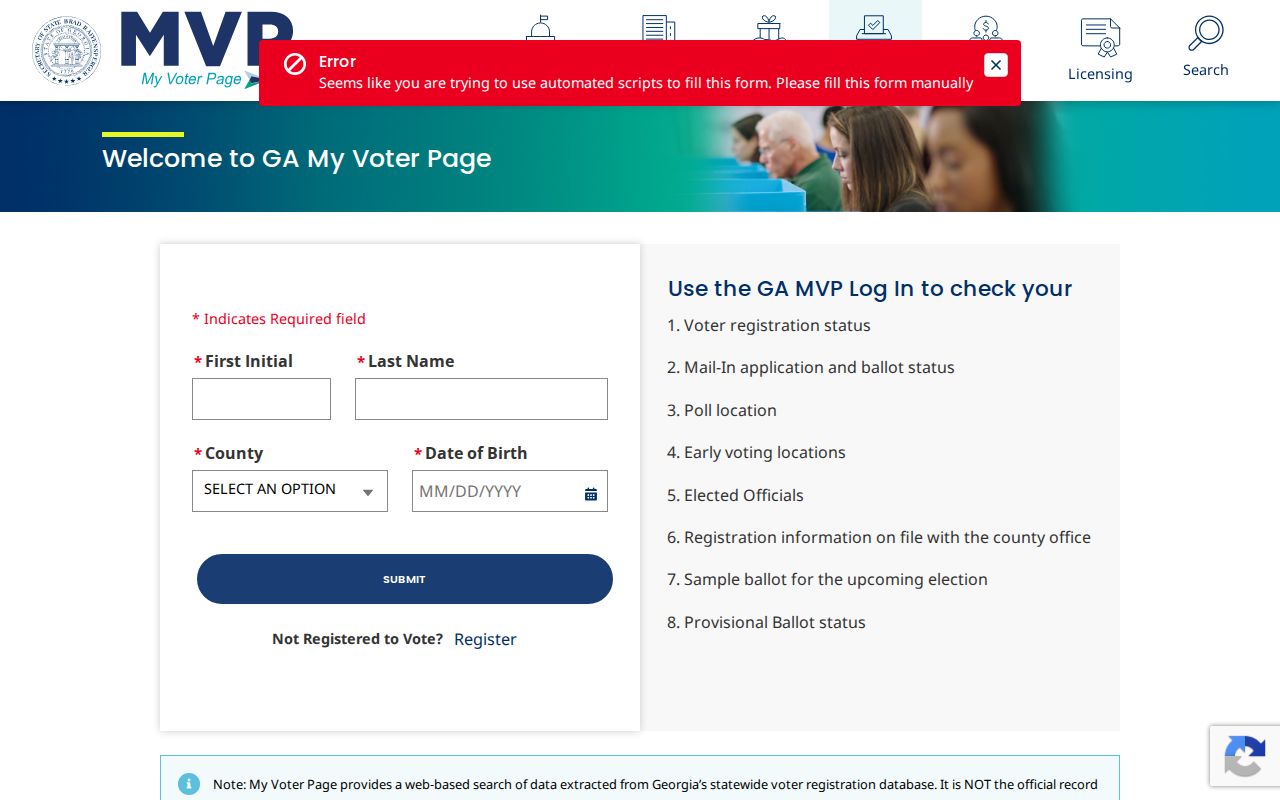
Use that form for its stated purpose and respect protected-address programs.
Verify Peachtree City Court Names
Georgia has no single trial-court search that covers everything. Peachtree City Municipal Court takes city ordinance and misdemeanor traffic cases. Fayette's Magistrate, State, Superior, and Probate courts each hold different county matters. Federal cases run through PACER. One empty result in one system clears nothing elsewhere.
A Fayette docket can carry a case number. It may also list a caption, party names, roles, filed date, cause, status, judge, hearing details, and docket events. Always read the role. The same name might belong to a plaintiff, defendant, petitioner, respondent, heir, or attorney. A charge is not a conviction. The filing date can also differ from the underlying event. Sealed, juvenile, adoption, and other restricted material stays closed to the public.
The Georgia Courts access page explains that trial-court searching runs through providers. An account may be required.
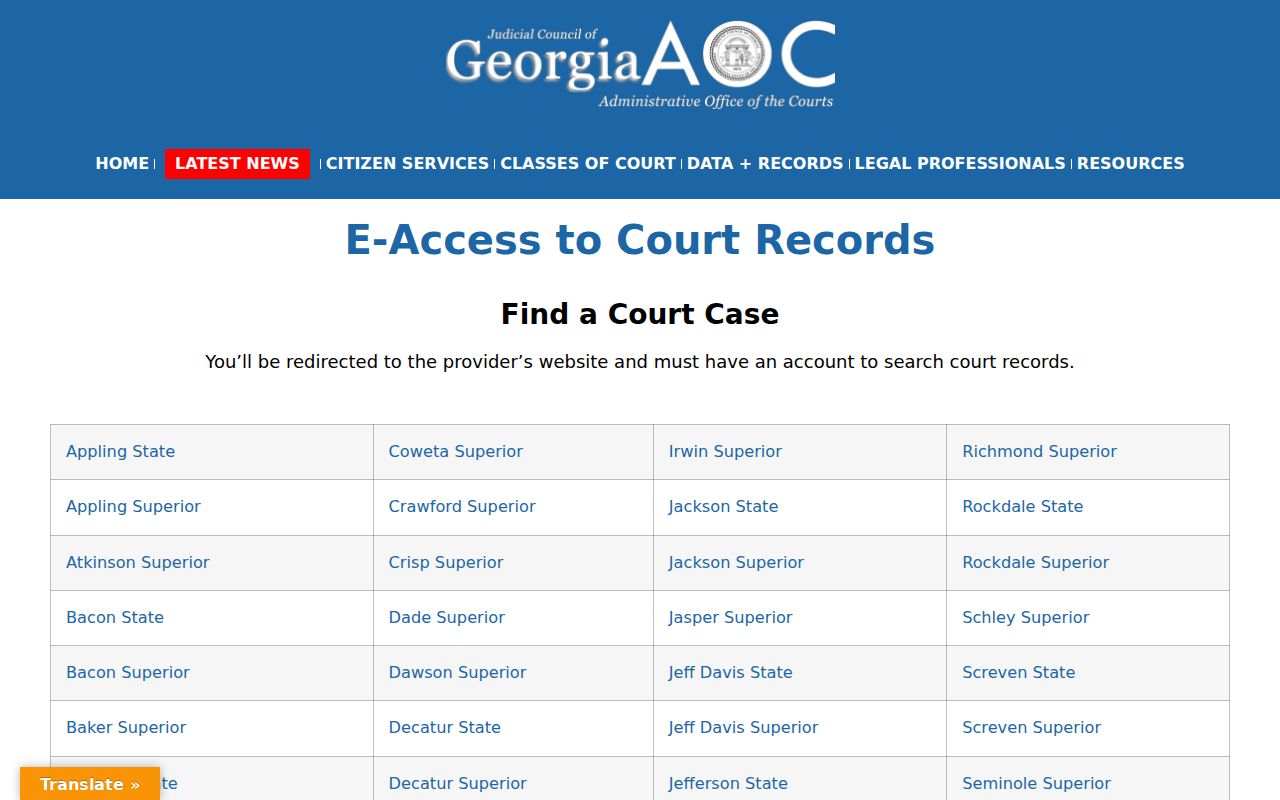
The provider map only routes a search; the local clerk keeps the actual file.
Lawful use. Peachtree City public records support family, property, safety, and civic research. Never use a name or address to stalk, threaten, harass, or harm anyone.
Peachtree City Vital Record Limits
Vital records work differently from open property rolls. Georgia DPH holds births and deaths dating to January 1919. It also holds marriage applications from 1952 through 1996, and divorce verifications. Fayette Probate Court handles marriage records outside that state range. It does so when the license was issued there, along with local birth and death service. Fayette Superior Court issues the actual divorce decree when that court granted it.
Certified copies of births and deaths require legal eligibility and identification under Georgia law. Georgia Archives offers historical death certificates from 1919 through 1943. Current requests can move through a county counter. They can also go through the state counter, mail, or an approved online service. The search fee pays only for the search. A record is never guaranteed.
The Georgia DPH request-method page lays out every available order channel.
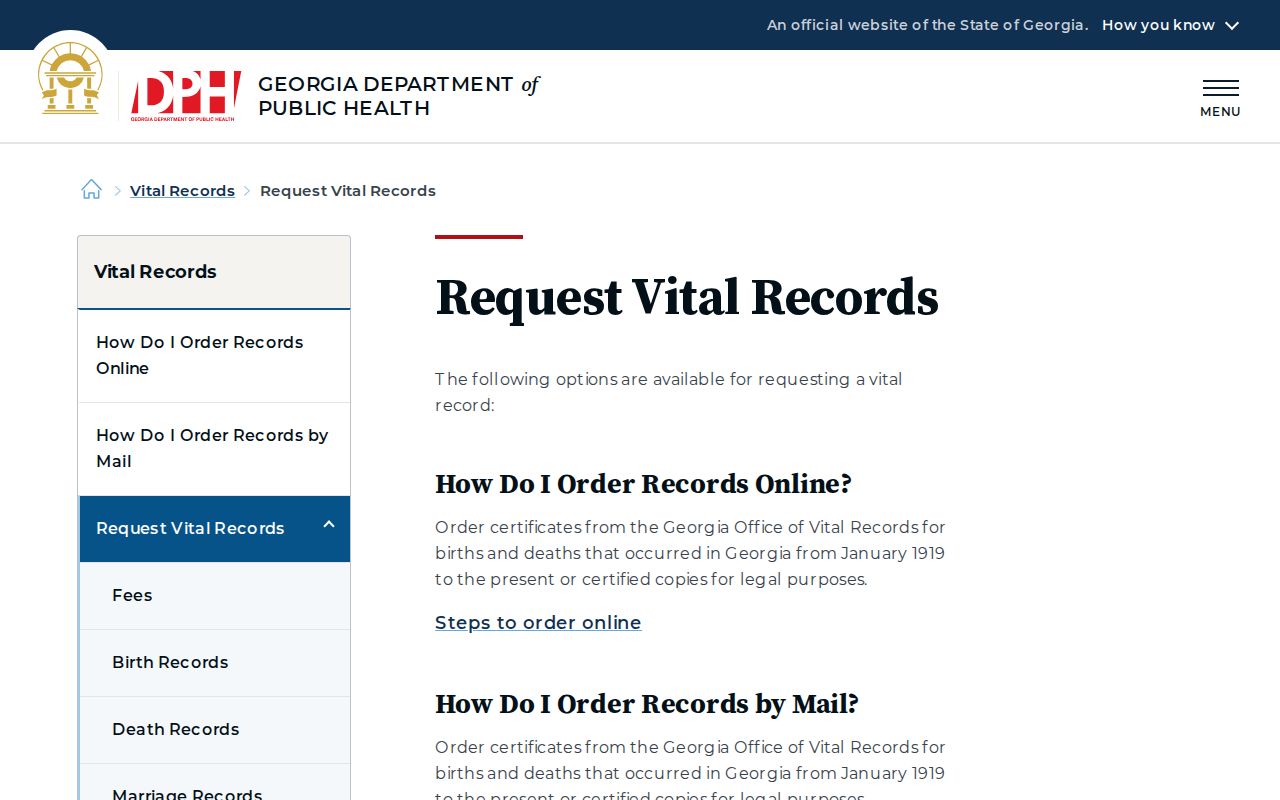
Check the live page before traveling, since service hours and processing windows can shift without notice.
Request Peachtree City Records
The Georgia Open Records Act, O.C.G.A. § 50-18-70 et seq., lets any person inspect or copy existing public records. Peachtree City accepts requests through NextRequest or by email to the city clerk. A strong request names the record, the date range, an address, a person, the department, and the preferred format. The city then has three business days to provide access, cite an exemption, or give a timetable.
One limit matters for resident research. An agency does not have to create a list that does not exist. Ask for a known permit report, city record, or correspondence set rather than demanding staff compile a new residents directory. After the first 15 minutes, search and redaction charges can apply. The city provides an estimate before work begins. Fayette County routes its own requests for county departments through a separate form.
The Peachtree City open-records instructions show the city clerk's request channels.
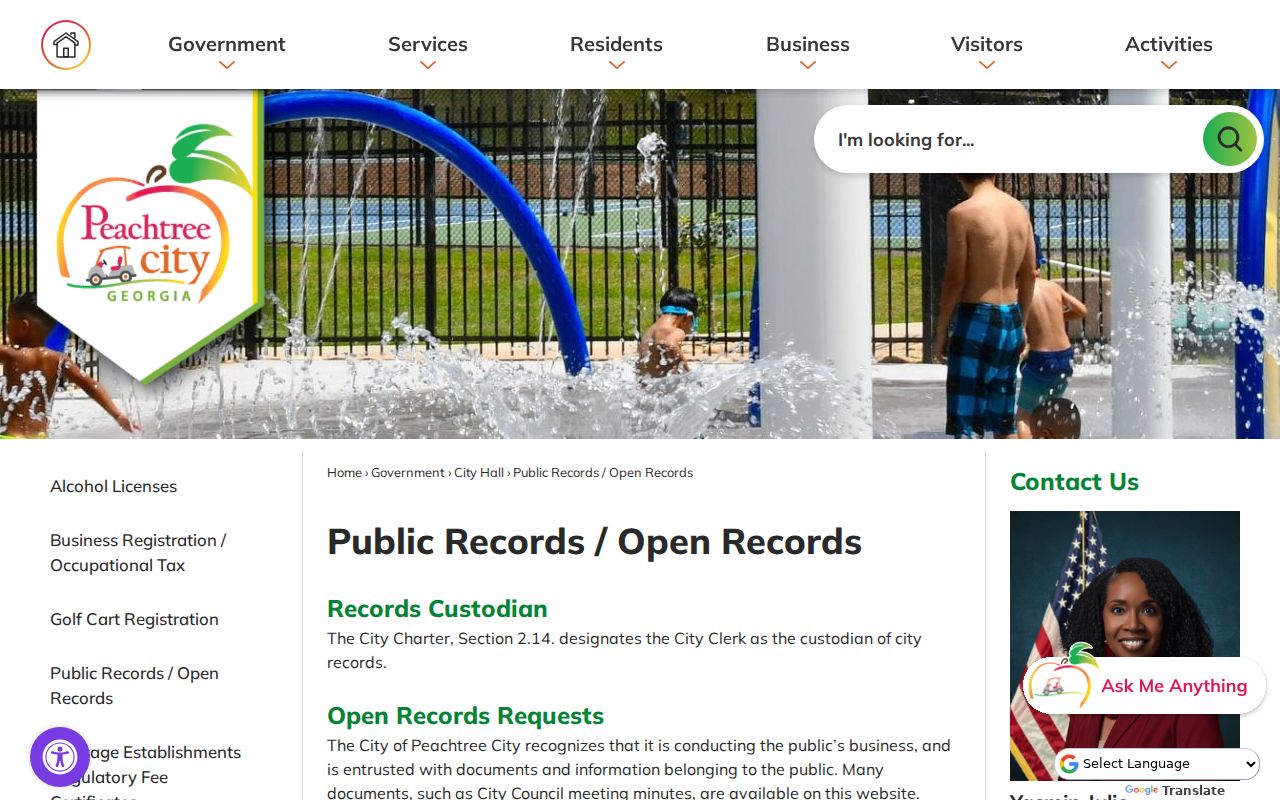
The linked instructions also explain estimates, redactions, and the three-business-day response framework.
Match Peachtree City Identities
Never trust a same-name result on its own. Pair the name with a second anchor. Try a parcel ID, street, filing year, middle initial, spouse, case role, license number, or known associate. Date-stamp every finding. Tax rolls, voter records, permits, and court dockets update on different schedules. Disagreement between them may simply reflect timing rather than an error.
When an official record is wrong, go to its custodian. The assessor corrects tax-card mailing addresses. The clerk answers recorded-document questions. Elections fixes voter registration. The court clerk handles docket and file matters. DPH or Probate handles vital records. A commercial index cannot change the underlying public record.
What if the name still does not match? Try maiden names, initials, business entities, spelling variants, and the older legal description. Then ask the custodian whether the missing years require an in-person book or file search.
Trace Peachtree City Heirs
Probate becomes the next step when a property or obituary trail ends with a deceased owner. That trail has simply run dry. Fayette Probate Court keeps estate petitions, wills, and related proceedings. A petition may name the decedent, petitioner, heirs, addresses, and case year. Guardianship and mental-health material can be restricted. Absence from a public view does not mean no file exists.
Start with the death date and county. Then request the estate index or file using the decedent's full name and approximate year. Compare heirs named in the probate papers against deeds and obituaries. Land may have passed through an estate. The later deed or assent may cite the probate case number. Treat this as a family-history and estate trail, not proof of anyone's current home.
Peachtree City Historical Directory
Peachtree City was chartered in 1959. Because the town is young, its historical residents directory strengths lie in modern records rather than long runs of nineteenth-century city directories. The Joel Cowan History Room opened in 1987, works by appointment, and preserves developer files, city records, civic publications, photographs, maps, newspapers, drawings, and oral histories. Its interview project began in 2002. Transcripts are searchable. Abstracts, page references, and timestamps come attached.
Land before the planned city takes different tools, starting with modern plats and legal descriptions before reaching further back. Fayette deeds, early tax digests, census records, cemetery publications, and Georgia Archives microfilm cards carry the trail back. The first Fayette tax digest covers 1823 through 1834. A county cemetery survey helps link older families to burial grounds, and a dedicated Peachtree City city directory page covers the collection workflow in depth.
Peachtree City Directory Boundaries
Public records never name everyone at one address. Utility customer data and motor-vehicle addresses stay limited. Protected voter addresses, sealed cases, juvenile files, and many vital records stay closed. Private HOA rosters are not public. Membership in a Peachtree City neighborhood association changes nothing. A ZIP result only validates mail format, not occupancy or city jurisdiction.
Use the least intrusive source first. Link back to the official custodian instead of republishing personal details. Recorded deeds confirm a seller. Consent-based channels reconnect relatives, while probate records and archives serve family history. If a resident lookup in Peachtree City raises a safety concern, stop. Georgia stalking and harassing-communications laws apply. The laws hold even when the first fact came from a lawful public index.
Note: VoteSafe and Safe at Home protect qualifying people. These programs allow full public-life participation without exposing a residence address.