
Peachtree City Lookup Record Map
Official sources answer narrow questions. Fayette County's property roll links a titled owner to a parcel, while the court docket links a party to a filed case. Georgia voter and vital systems use different rules. Pick the record that fits the fact being checked, then note the search date and jurisdiction. That discipline keeps a Peachtree City resident lookup from joining two people merely because their names match.
| Record | What It Confirms | Where to Search | Access |
|---|---|---|---|
| Assessor parcel | Owner, mailing and situs address, sale | Fayette qPublic | Free; not occupancy proof |
| Deed | Named transfer and legal description | Fayette property index | Index; copies through clerk |
| Court docket | Party role, case type, date and status | Fayette online services | Open files; restricted cases excluded |
| Voter record | Personal registration and precinct | Georgia My Voter Page | Identifying inputs; VoteSafe applies |
| Vital or probate record | Event, relationship, estate role | Fayette Probate or Georgia DPH | Eligibility depends on record |
| Business or license | Public filing or credential role | Georgia SOS | Free index; not residence proof |
An address and owner question belongs in qPublic first. A known lawsuit belongs in the Fayette docket. Family links may require Probate Court, Georgia DPH, the public 1919-1943 death certificates, or an actual Superior Court divorce file. Business and professional records can distinguish names, but they show a filing or credential, not a home.
Match Peachtree City Residents Twice
Normalize the full name before searching. Keep a suffix, middle initial, maiden name, or former business spelling. Then demand two independent anchors. A parcel address plus the same person's role in its deed is a sound pair. A voter precinct plus a matching public business filing can also help, when access is lawful. A tax mailing address may be remote, so it cannot prove that an owner lives at the parcel.
- Search qPublic by owner name and record the parcel, situs address, mailing address, sale date, and deed book/page.
- Open the deed index and confirm that the same person appears in the transfer for the same legal description.
- Check a second relevant index, such as the court docket or a public license filing, using name variants.
- Date-stamp each result. Resolve conflicts with the office that keeps the primary record.
This focused resident lookup is stronger than a broad compilation. If the goal changes to other people along the same road, the Peachtree City street directory explains address-led work without turning one person's file into a block search.
Confirm Peachtree City Property Names
The Fayette Clerk property index is the next stop after an assessor card supplies a deed book/page or sale date. The public landing page does not state an exact online start year. Older books and indexes therefore require inspection at the clerk or a check of Georgia Archives county microfilm cards. Online entries are informational, not certified proof.
The official entry screen used for this Peachtree City resident lookup is shown below.
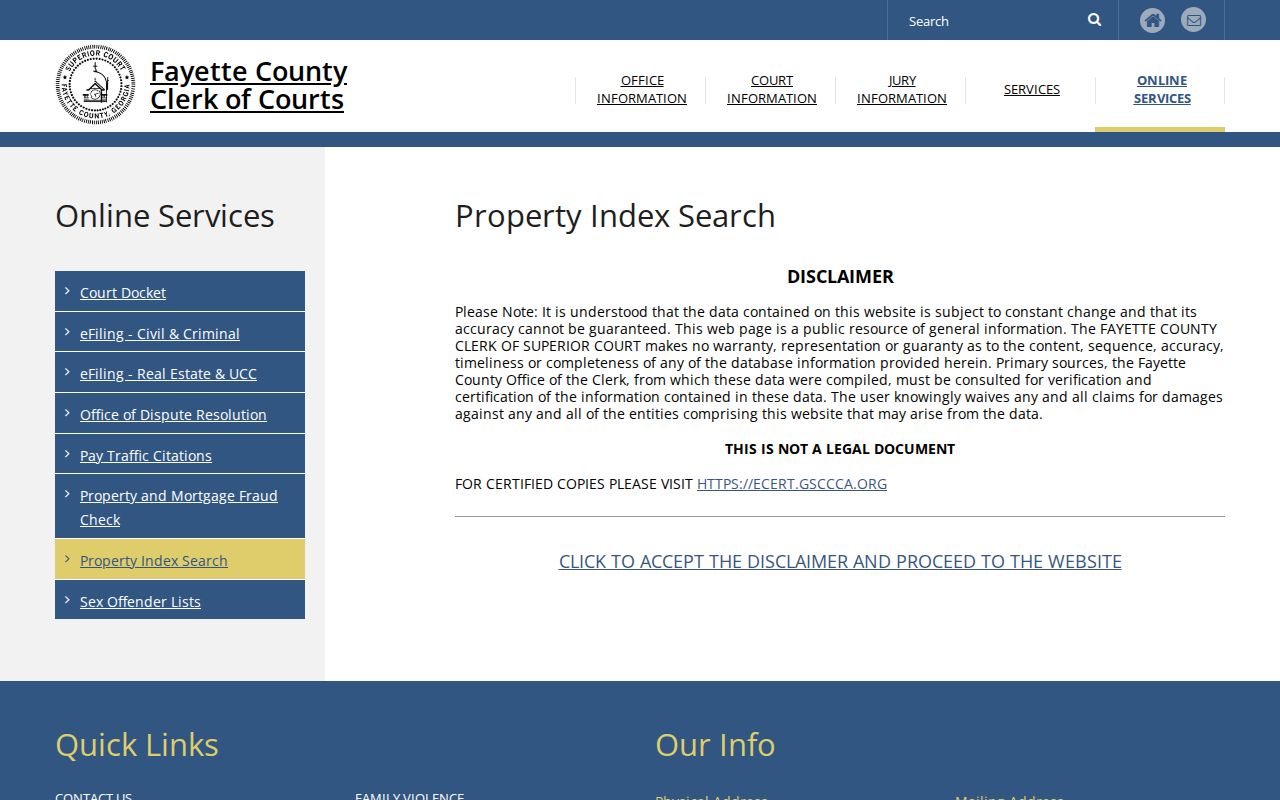
The disclaimer matters: match grantor, grantee, recording data, and legal description, then obtain the primary image or certified copy when authenticity is important.
Read Peachtree City Court Results
Peachtree City cases are split by court. Municipal Court handles city ordinance and misdemeanor traffic matters. Fayette Magistrate, State, and Superior Courts have distinct jurisdiction, and Probate Court handles estates and wills. Georgia has no single complete statewide trial-court or traffic-citation database, so a no-result screen in one system is not a statewide answer.
| Result field | What to check |
|---|---|
| Case number and filed date | Identify the file and its year |
| Caption and party role | Distinguish plaintiff, defendant, petitioner, respondent, or attorney |
| Cause, category, status | Read the court's terms; do not equate a filing with an outcome |
| Judge, hearing, courtroom | Confirm the listed proceeding |
| Docket event or link | Locate the item, then request the actual open file if needed |
Search by case number when possible. Otherwise use last name, first name, court or case type, and filed year. The clerk counter is open weekdays for supervised inspection; sealed, juvenile, adoption, and other restricted material stays closed.
Order a Fayette Court Record
A docket is only an index. Fayette's civil and domestic copy form asks for the parties, case year and number, document type, requester contact details, and delivery method. Certified and expunged copies cannot be emailed. The clerk accepts phone payment by listed cards or payment by mail, and the official fee schedule should be checked before an order.
- Docket
- The dated list of filings and events in one court case.
- Index versus image
- An index points to a record; an image reproduces the filed document.
- Certified copy
- A copy bearing the clerk's seal or certification as an official reproduction.
Ask for a named document rather than every item tied to a person. A judgment, final order, complaint, agreement, or decree answers a clearer question and avoids needless cost.
Confirm Peachtree City Family Links
Vital records are not ordinary open records in Georgia. DPH holds births and deaths from January 1919, marriage records for 1952-1996, and divorce verifications. Fayette Probate Court is the route for county marriage records outside that state span, while an actual divorce decree comes from the Superior Court that granted it. Birth and death copies require statutory eligibility and identification.
The Fayette Probate Court handles estates, wills, marriage, and local vital-record service. Its official page appears below.

Probate petitions, wills, and notices can identify a decedent, petitioner, or heir. Sensitive guardianship and mental-health matters may be restricted, so contact the court with a decedent's name and approximate year rather than assuming an online name index exists.
Find Heirs and Old Friends
A resident lookup often has a human purpose. For an heir, begin with the decedent's estate petition, will, and published notices. For birth-family research, use Georgia's official adoption reunion or registry process rather than trying to bypass closed birth records. Classmates are better traced through school yearbooks, library newspapers, and alumni channels. The Joel Cowan History Room's civic publications and oral-history transcripts can help with longtime or founding residents.
Obituaries can name relatives, past communities, and cemeteries, but they are reported accounts. Compare dates and relationships with death, probate, cemetery, or census sources. A person who vanishes from one roll may have moved, changed a name, died, or simply fallen outside that source's scope.
Note: Family-history clues become reliable only after dates, relationships, and names agree across independently kept records.
Check Peachtree City Affiliations
Georgia's Business Search can show an entity's legal name, control number, type, status, principal office, registered agent, and filing history. The professional license search can show a licensee, board or profession, number, status, dates, and public discipline where posted. Search former names and spelling variants.
These records can separate two people who share a name, yet neither is proof of a current home. A registered-agent address may serve a company. A public professional contact can be a business location. Peachtree City occupation-tax or alcohol-license records may add a local filing, but request the existing register from the city clerk rather than asking staff to compile a new resident list.
Use Georgia Leads with Care
Georgia unclaimed property can supply a prior name or address association, but claim details and proof of identity remain protected. Treat any match as a lead. It does not establish where a person lives now.
The Georgia Department of Revenue program provides the official route shown here.
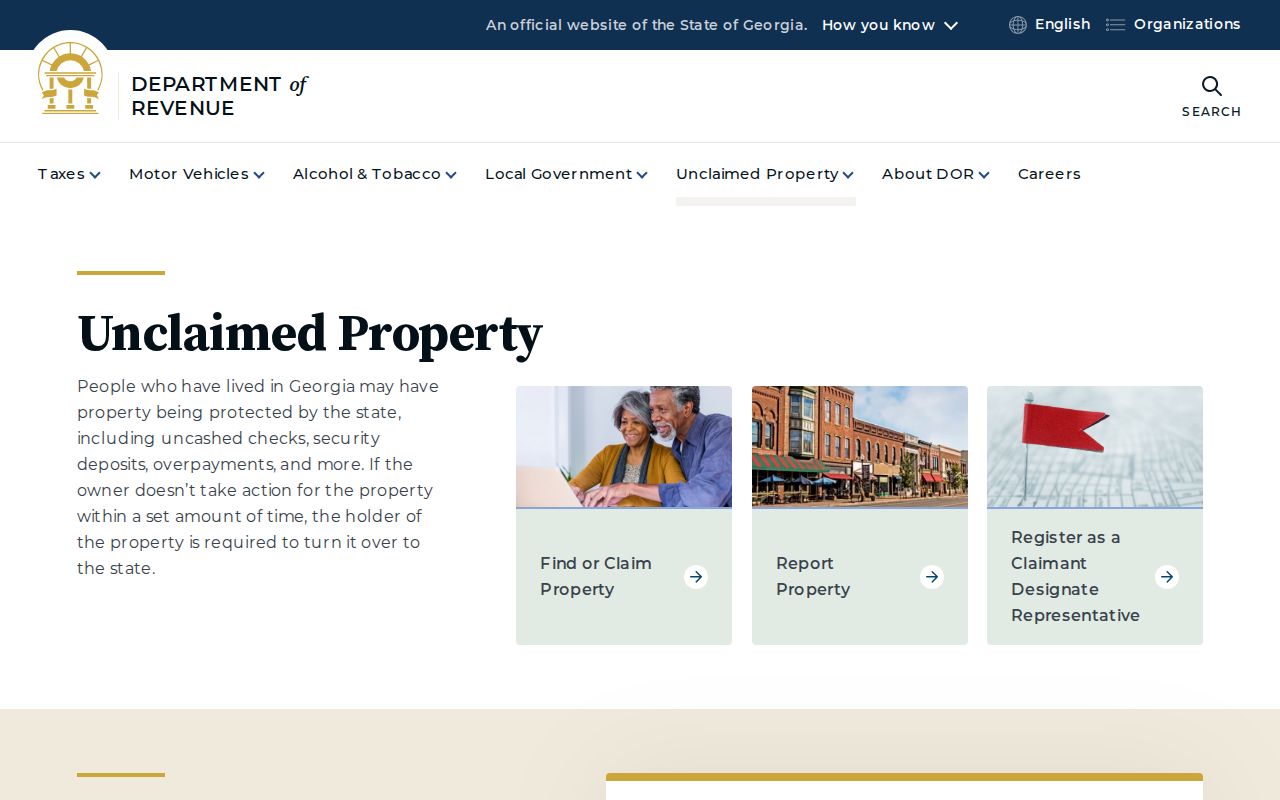
An official search also avoids solicitations that demand an advance fee. Verify the agency address independently and follow its claim instructions.
Separate Custody from Residence
The Georgia Department of Corrections offender query is a state-prison search, not a general Peachtree City resident lookup. It can distinguish a name with identifiers and show a state custody record, location, or status. It does not cover every county detainee and should never be read without its update date.
The state query form is pictured below.
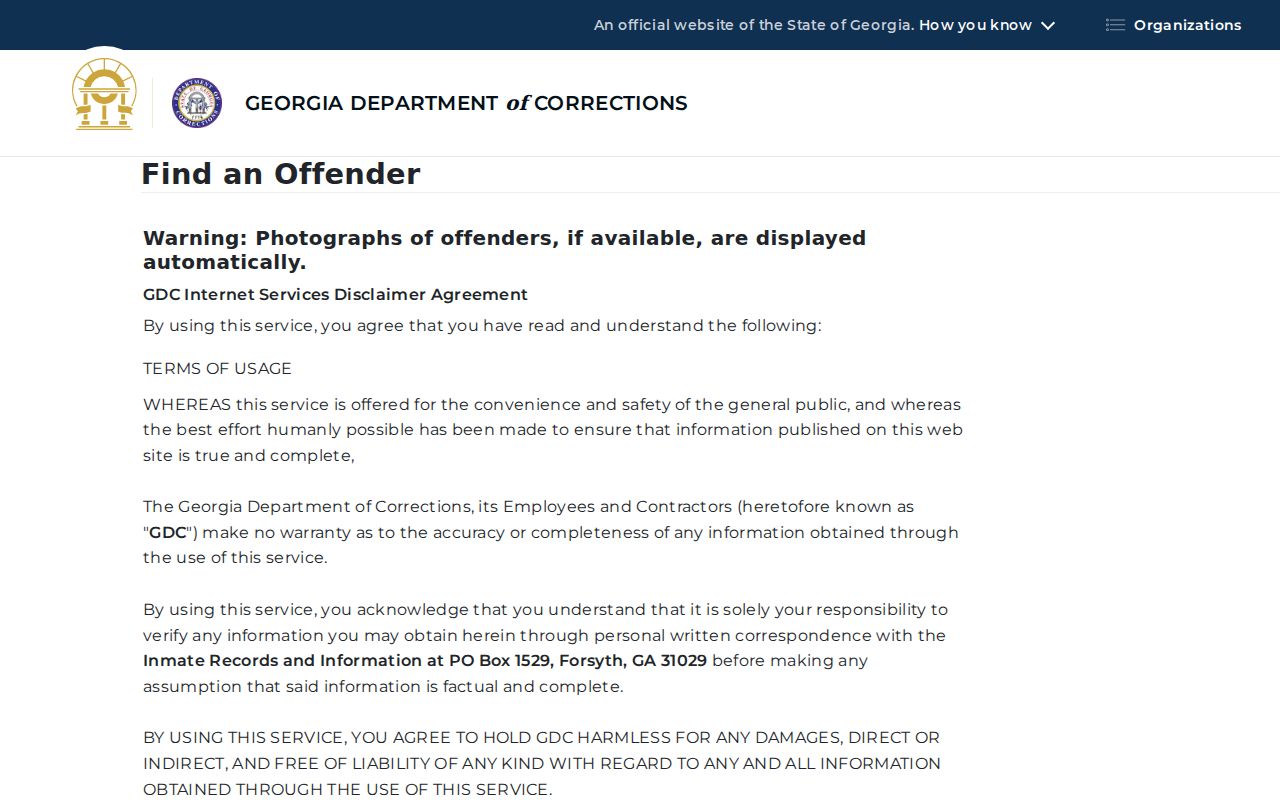
For a present county custody question, contact the Fayette Sheriff's Office. For filed charges and disposition, return to the court docket and the certified clerk file. Each channel answers a different question.
Resolve Peachtree City Record Conflicts
When two records disagree, go to the custodian. Ownership corrections require a recorded deed and assessor documents. Voter address or status questions go to Fayette Elections or My Voter Page. Court index errors go to the clerk. Vital amendments go to DPH and may require certified proof or a court order.
- Save the exact name, record type, search mode, jurisdiction, and date used.
- Check whether the result is an index, an image, or a certified primary record.
- Give the custodian the case, parcel, instrument, or certificate details that identify the record.
- Request correction through that office's process, not through an unrelated search service.
- Custodian
- The office legally responsible for keeping a record.
- Primary record
- The filed or issued document, rather than a search result that points to it.
- Record restriction
- A Georgia process that limits eligible criminal-history access but does not erase every courthouse reference.
Peachtree City Lookup Privacy Limits
Public access has firm edges. VoteSafe protects qualifying registered voters' residence addresses, and Safe at Home supplies substitute addresses for eligible survivors. Motor-vehicle personal data is restricted by federal law. Georgia vital records follow O.C.G.A. § 31-10-25, while sealed court files, juvenile cases, adoption material, and protected victim details are not opened by a general records request.
Commercial compilations can be stale and can merge people with the same name. Removing a listing from one compilation does not change a deed, tax card, or court record. Corrections and lawful redactions belong with the official custodian. Under the Georgia Open Records Act, an agency provides existing public records; it does not have to build a personal dossier that does not exist.
Lawful use. A Peachtree City resident lookup is for lawful personal research. Georgia law prohibits using records to stalk, harass, threaten, or intimidate anyone.