
Peachtree City Neighbor Source Map
One block has several public layers. Fayette GIS supplies parcel geometry. The assessor card identifies each titled owner and tax mailing address. A municipal voter file can be sorted by residence address under Georgia's access rules, while city permit and code files document work at a place. None of these is a full household roll, so looking up Peachtree City neighbors means combining only the records that answer the question at hand.
| Source | What It Shows About a Block | Access |
|---|---|---|
| Fayette GIS parcels | Lot shapes and parcel IDs around the target | Free map |
| Fayette parcel cards | Titled owner, situs, mailing address, sale | Free qPublic search |
| Municipal voter list | Registered names and residence addresses | Paid electronic file; use limits |
| City permit or code file | Address-specific project and record history | Portal or records request |
| Historic civic publications | Printed officers or members from an era | History Room appointment |
| Private association roster | Only what an association chooses to provide | No general public entitlement |
A deed or parcel card proves a title link on its record date. It does not identify renters, children, guests, or all other occupants. A matching homestead indicator and mailing address may support owner occupancy, yet it remains date-sensitive. Preserve the parcel ID and legal description, since they are safer anchors than a name alone.
Click Around Peachtree City Parcels
The defensible block method does not need a radius tool. Search the target address in the Fayette qPublic GIS map, zoom until parcel lines and street labels are clear, then click each touching polygon. Record its parcel ID and open its card. Repeat on the same side of the road and directly across it if that area defines the practical block.
- Find the target by address or parcel number and verify the street label.
- Zoom to block scale, keeping roads and parcel boundaries visible.
- Click each adjoining polygon and save its parcel number.
- Open each linked property card and distinguish situs from mailing address.
- Date the results and note which lots merely sit nearby rather than touch.
This process maps owners around one point. For a full road from end to end, use the Peachtree City street directory, which follows the broader address chain.
Separate Owners from Peachtree City Households
On a Fayette card, situs means the physical property location. Mailing address is where the tax notice goes. They can differ. A remote mailing address may point to an owner who lives elsewhere, while a matching address still does not list every person in the home. Deed book/page and sale date help confirm title, not occupancy after the sale.
- Parcel
- A mapped unit of land identified by the county.
- Situs address
- The street location assigned to the physical property.
- Tax mailing address
- The destination for owner correspondence, which may be a PO box or other address.
- Legal description
- The land identity in a deed, often a subdivision, lot, land district, or land lot.
When a parcel result looks wrong, compare its legal description and map shape. Peachtree City's streets arose village by village after the 1959 charter, so older land may appear under tract or land-lot terms rather than today's road.
Read Peachtree City Block Registration
Georgia's My Voter Page is a credentialed one-person lookup. It is not a browse-by-block tool. A researcher who needs a lawful block view must obtain the standardized municipal or precinct voter file, then sort its residence-address field. The municipal voter list costs $65 under the pricing effective July 1, 2024, arrives electronically, and currently takes about two weeks according to the Secretary of State.
The file can include registered names, addresses, status, and participation dates. It excludes telephone numbers, dates of birth, Social Security numbers, and driver-license numbers. Georgia does not register voters by party, and participation history never reveals ballot choices. VoteSafe protects a qualifying voter's residence address. Registration can also lag a move.
| Official route | Best use | Key limit |
|---|---|---|
| My Voter Page | Check one's own status, precinct, and polling place | Identifying inputs; no block browse |
| Municipal voter file | Sort registered addresses on a Peachtree City block | Paid product; VoteSafe and use rules apply |
| Fayette Elections request | Ask for an existing election record | No custom database must be created |
Note: Georgia law makes elector names and addresses public, but O.C.G.A. § 21-2-601 prohibits commercial use of voter lists.
Place Neighbors in Five Villages
Aberdeen, Braelinn, Glenloch, Kedron, and Wilksmoor are Peachtree City's meaningful village geography. They are not ZIP codes or separate jurisdictions. Village and subdivision names can help search parcel legal descriptions, permits, newspapers, developer files, and civic publications. They also explain why nearby roads may have appeared in different phases of the planned city.
Community context does not turn a village into a resident directory. There is no verified official citywide HOA member list. Each association is private and subdivision-specific. Public city boards, Friends of the Library, chamber materials, and historic civic publications can provide public contacts or named officers without exposing a private roster.
Trace Peachtree City Civic Neighbors
The appointment-only Joel Cowan History Room keeps civic-club publications, city records, maps, newspapers, photos, and oral histories. Printed newsletters or event programs may name officers and members from a specific year. Those historical names should be read as an era snapshot, not as a current block roll.
The collection's mandate includes clubs and organizations. Friends of Peachtree City Library also has an older corporate identity, Peachtree City Library, Inc., which can help when searching organizational records. For earlier county families and burial grounds, Fayette Historical Society's family books and cemetery survey add context outside city files.
Note: Contact the History Room with a village, street, organization, and date range because the collection is non-circulating and appointment only.
Compare Peachtree City Neighbor Tools
Official rolls and commercial neighbor tools do not carry the same weight. A public parcel record identifies titled property. A voter file reflects registration at its production date. A commercial compilation merges public and purchased data, may conflate names, and is not authoritative. Use the narrow official source that owns the fact.
| Source type | Strength | Weak point |
|---|---|---|
| County parcel and deed records | Primary owner and land identifiers | No complete household list |
| Official voter file | Produced registration fields | Not all adults; address may lag |
| City permit or code record | Dated facts about one address | Applicant may not be an occupant |
| Commercial compilation | May gather broad leads | Stale, derivative, and prone to name merges |
Never assume an absent official result means a person is absent. It may reflect source scope, timing, confidentiality, or an owner who differs from the household.
Request Peachtree City Address Files
City permit, certificate-of-occupancy, violation, plan, and code-history files can add dated facts about a block. Peachtree City posts recent monthly permit reports, while older archives and full files are routed through the City Clerk. A request should name the address, record type, and date span. Georgia's Open Records Act requires a response, access, denial, or production timetable within three business days, but it does not require staff to create a new neighbor database.
The Peachtree City NextRequest portal is one official submission channel.

A precise address request is more useful than asking staff who lives nearby. Personal details may be redacted, and the city supplies existing records rather than answering a broad research question.
Route Fayette Neighbor Records Correctly
County records have separate custodians. The assessor and GIS hold parcel data. Fayette Elections handles election records. The Clerk of Courts keeps deeds and court files, while Sheriff's records follow their own request route. Sending one broad request to the wrong office slows the search and can obscure which record is actually needed.
The Fayette County request-routing page shows the office split.
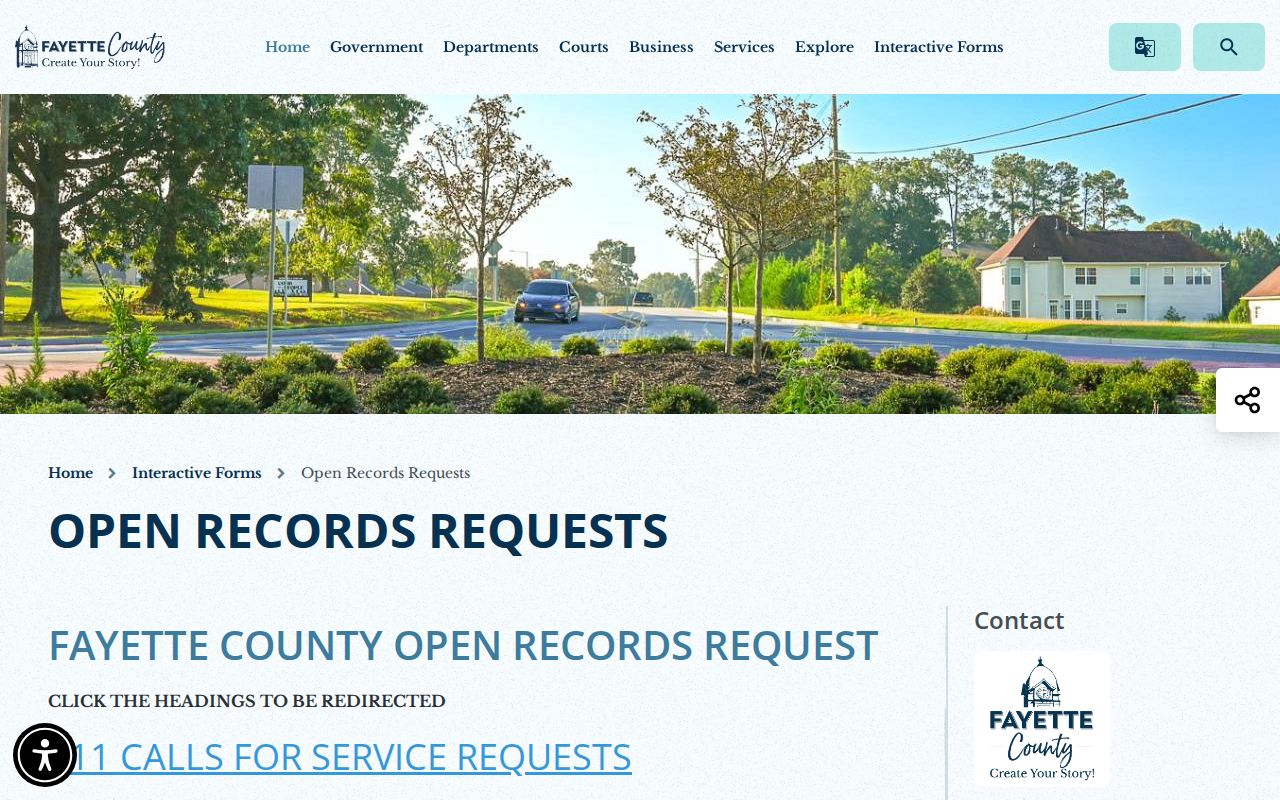
Ask for an existing parcel, election, incident, permit, or court record by its own identifiers. A general question about Peachtree City neighbors is not itself a record request.
Use Safety Records Lawfully
The Georgia Bureau of Investigation registry is an official public-safety source with statutory warnings. It is separate from GIS, property title, and voter records. Read the record's status and address date, then verify through the responsible registering agency rather than treating a map point as a full account of a person or household.
The official registry information page is shown below.
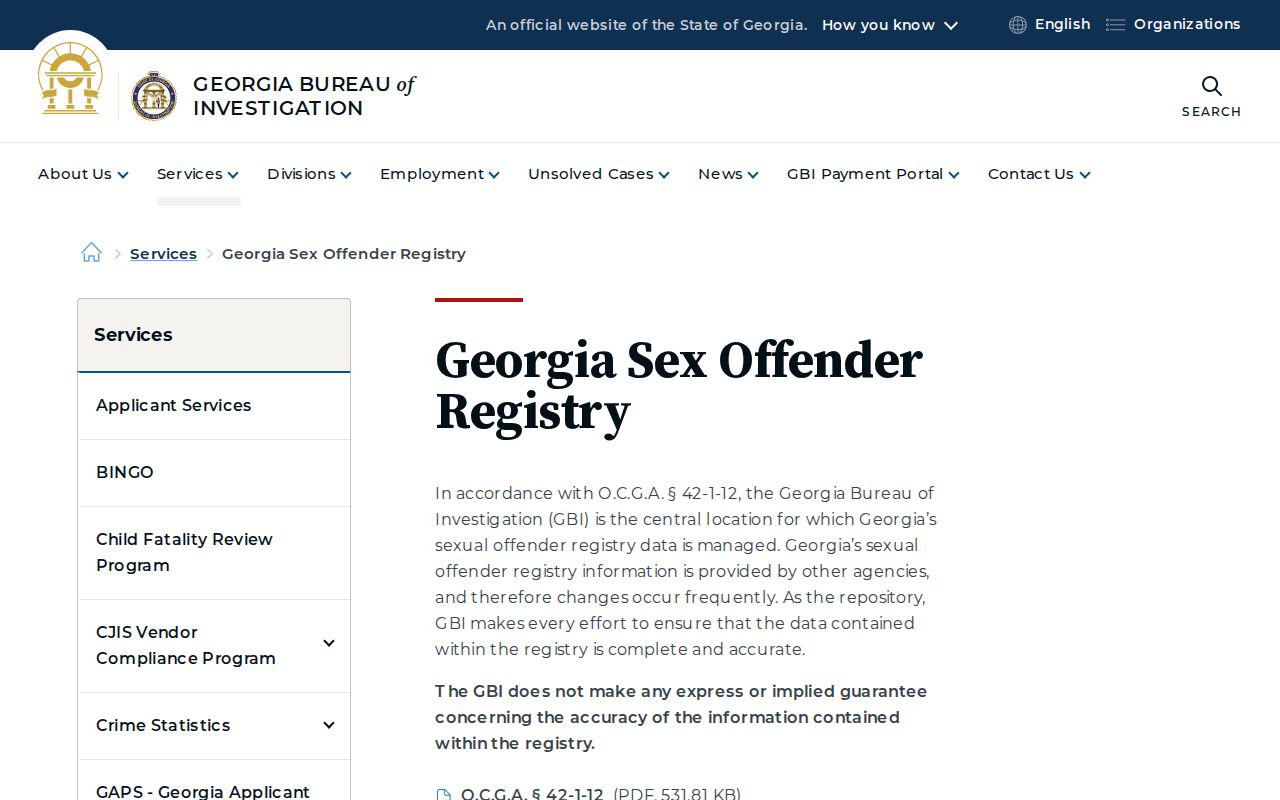
Use this source only for its lawful public-safety purpose. It does not supply a general directory of everyone on a Peachtree City block.
Verify Peachtree City Parcel Context
After mapping adjacent lots, compare each property card with the deed or plat only when title needs proof. Parcel ID and legal description keep the chain straight. The current owner's acquisition deed identifies grantor and grantee, while a plat explains the subdivision, lot, block, and easements.
- Confirm that the GIS polygon and property card share the parcel number.
- Compare situs and tax mailing addresses without treating either as a household list.
- Use sale date or deed book/page to find the matching title instrument.
- Keep the legal description constant when street spelling or development phases cause doubt.
The block view should remain small and specific. It is designed to show the parcel setting around one address, not to recreate a citywide owner file.
Protect Peachtree City Neighbor Privacy
Public systems do not offer dependable lists of renters or all household members. Utility, delivery, and motor-vehicle address data are not neighbor directories. VoteSafe and Safe at Home protect eligible survivors' addresses, and a missing address must not be reverse-engineered through other rolls. Private HOA, congregation, and block-watch rosters remain private unless the organization chooses to publish or share them.
Georgia stalking law applies when public information is used for following, surveillance, intimidation, or unwanted contact. Keep searches tied to property curiosity, civic research, family history, or legitimate personal safety. Do not republish more personal detail than the task requires.
Lawful use. Peachtree City neighbor records may support lawful civic and personal research. Never use them to watch, stalk, harass, threaten, or intimidate anyone.